May 2024 Blog
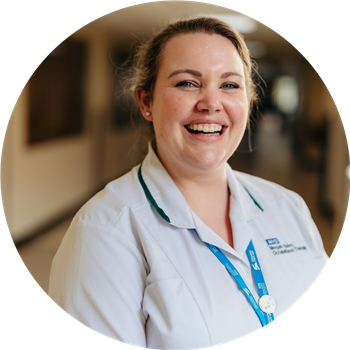
Megan Hales; Nursing, Midwifery and AHP Information Support Officer at the QEHKL
A Clinical Voice in a Digital World
My name is Megan Hales and I am currently employed as a Nursing, Midwifery and AHP Information Support Officer within the EPR Programme Team at The Queen Elizabeth Hospital. For the past 12 months, I have had the opportunity to retain a clinical role as an occupational therapist while leading with the roll out of the Norfolk and Waveney Shared Care Record at QEH and supporting with various tasks required in preparation for our planned EPR implementation.
Working across both roles in tandem has allowed me to apply clinical insights to digital transformation tasks and to test, validate and benefit from the implementation of the Shared Care Record within various clinical pathways.
When I was first approached about this role, I was uncertain about what I could offer as a clinical colleague to a digital transformation project. However, as I found my voice in this ‘new world’ I soon realised that the following clinical skills are invaluable to digital transformation:
- Clinical Reasoning: The complex cognitive process that we apply to evaluate and manage a patients’ condition provides vital insights when exploring our current ways of working across various clinical pathways. It is imperative for us to understand our workflows as they are, so that we can begin to imagine how this will translate to what will be at the point of EPR implementation.
- Risk Analysis: Working as a clinician in healthcare, risk analysis becomes part of our unconscious competence. We have had so much practice with this skill that it has become embedded in our clinical reasoning in our familiar, clinical context and can be performed with ease. With some guidance and support, we can translate these skills to risk analysis in digital clinical safety – and support with ensuring that hazards and controls are identified and considered during design and deployment of Health IT solutions to optimise patient safety.
- Multi-disciplinary working: Collaborative working is a crucial part of the biopsychosocial model of health. This EPR programme requires clinicians to translate this approach to work together with administrative, operational, and digital colleagues – with the patient remaining at the centre of system design.
It is for this reason that I am thrilled to see the working relationships and collaboration between administrative, operational, digital, and clinical colleagues grow – recognising the importance of working together to ensure that this vital step in our digital transformation journey is well-managed, to ensure that the benefits for both patients and staff are realised.
This is not the first programme which has seen all three acute Trusts across the system working together to deliver improved patient care. My recent involvement in the Norfolk and Waveney Shared Care Record allowed me to experience the benefits of working together with colleagues from NNUH and JPUH to deliver a system which staff across all three sites are excited to use, due to the visibility of information from other organisations. Positive use cases are already pouring in:
“I had a patient that we were urgently trying to get hold of but were unable to. I looked on the ShCR and it showed that he had been admitted to the JPUH Emergency Department. This was extremely helpful to a) know that he had been admitted and b) what the plan was for treatment.”
“A midwife needed to call a patient that had their baby at JPUH. Prior to speaking with the patient, the midwife learned from information documented on the ShCR that, unfortunately, the baby had passed away. She was therefore able to navigate the conversation with the patient differently.”
The collaborative efforts of all 3 acute Trusts to support the Norfolk and Waveney Shared Care Record Project has provided a solid stepping stone on our journey to better joined-up care. Imagine what we will be able to achieve with a single point of truth guiding best practice standards of care through our Electronic Patient Record.